

The holiday season provides an excellent opportunity for small businesses to connect with customers, promote seasonal products and services, and finish the year on a positive note.
For retailers, the possibilities are fairly obvious. Holiday sales, gift certificates, special offers, and seasonal merchandise can attract considerable interest. However, holiday marketing isn’t limited to retail businesses. Restaurants, contractors, professional service providers, and other businesses can also benefit from thoughtful seasonal promotions.
Over the years, I’ve helped clients prepare websites, promotional graphics, and social media content for the holidays. One thing I’ve learned is that effective holiday marketing doesn’t necessarily require an elaborate advertising campaign or a large budget.
Sometimes a well-designed website banner, a timely email newsletter, or an attractive promotion on social media is enough to encourage customers to take notice.
The important thing is to plan ahead, maintain consistent branding, and make it easy for customers to understand what you’re offering.
Start Planning Before the Holiday Rush
Although I personally prefer to see Christmas decorations after Thanksgiving, I recognize that businesses need to begin planning their holiday promotions well before then.
If you’re preparing graphics, updating website content, organizing a special event, or developing a promotional campaign, leaving everything until the last minute can make the process unnecessarily stressful.
My suggestion is to begin by deciding what you want your holiday marketing to accomplish.
For example, are you trying to increase sales, promote gift certificates, book appointments for the coming year, attract customers to an event, or simply thank existing customers for their business?
Once you’ve established your objective, you can decide which promotional activities will best support it.
Consider the time needed to prepare promotional materials, update your website, schedule social media posts, and notify customers.
Some campaigns may require only a few days of preparation. Others, particularly those involving events, inventory, shipping, or printed materials, may need to be planned much further in advance.
Create Attractive Holiday Graphics
One of the simplest ways to bring attention to a holiday promotion is through seasonal graphics.
These might include a homepage banner, a promotional image for Facebook or Instagram, an email newsletter header, or graphics for a special event.
From a design perspective, I recommend maintaining a balance between seasonal decoration and the existing visual identity of the business.
A holiday promotion should catch someone’s attention, but it shouldn’t overwhelm the page or make the website difficult to use.
In most cases, there’s no need to redesign the entire website for the holidays. A few carefully placed graphic elements can accomplish quite a bit.
Example: A Holiday Sale Banner
The following image is an earlier holiday promotion I created for Gilchrist Golf Cars.
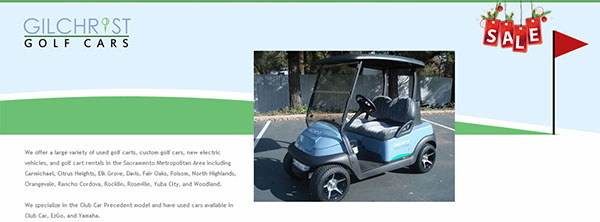
Rather than creating an entirely new design, I incorporated a sale graphic into the existing layout.
It’s a simple approach, but one that can be effective when the intention is to announce a limited-time promotion without significantly changing the website’s appearance.
Today, I would also consider how the banner displays on mobile devices, since a wide desktop graphic may not work particularly well when reduced to the width of a phone.
In some cases, I recommend creating separate versions for desktop and mobile so the promotional message remains prominent and readable.
Keep Promotional Messages Clear and Easy to Read
One mistake I sometimes see with promotional graphics is attempting to include too much information in a small space.
A banner doesn’t need to explain every detail of the promotion. Its primary purpose is to attract attention and encourage the visitor to learn more.
For example, a banner announcing a holiday sale might include the promotion name, a brief offer, and a button linking to the relevant page.
Additional information about participating products, restrictions, and expiration dates can be provided on that page.
I also recommend paying attention to the contrast between text and its background.
Decorative holiday images can make attractive backgrounds, but detailed photographs or patterns may interfere with readability.
In many cases, I prefer to use the decoration around the message rather than directly behind important text.
The same principle applies to promotional forms.
Example: A Holiday Event Registration Form
Another earlier project involved creating a holiday luncheon registration form for a client.
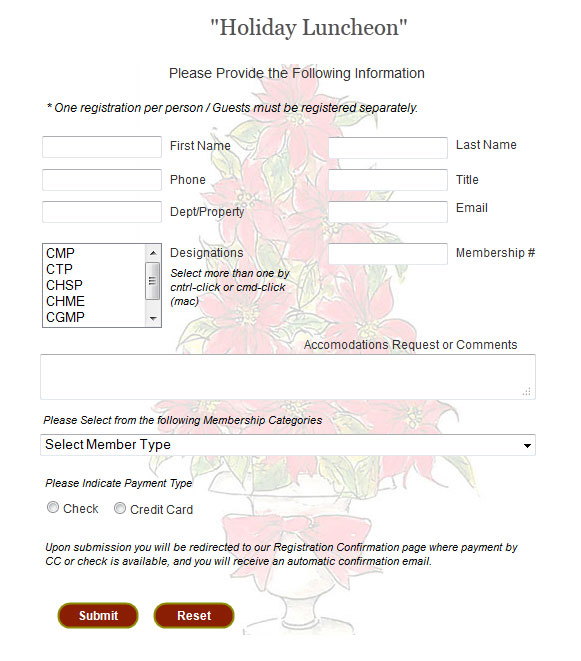
The idea was to introduce some holiday character into what would otherwise be an ordinary registration form.
Although the illustration was intentionally faded, today I would be more cautious about placing decorative imagery behind form fields. Clear labels, good contrast, and straightforward form layouts are especially important for accessibility and mobile usability.
For more information about text readability and contrast, the W3C provides guidance on accessible color contrast.
As a general rule, the decorative elements should complement the content, not compete with it.
Create a Dedicated Page for Your Holiday Promotion
If your holiday campaign involves more than a simple announcement, I recommend creating a dedicated promotional page on your website.
For example, a business might want a page featuring its holiday specials, gift certificates, seasonal services, or upcoming events.
The advantage of using a dedicated page is that you can direct visitors to one location for all the important information.
Depending on the promotion, that page might include:
- A description of the holiday offer or event.
- Photographs of the featured products or services.
- Promotion dates and important deadlines.
- Prices, discounts, or special purchasing options.
- Reservation, registration, or ordering information.
- Terms and conditions, where applicable.
- A clear button or form for taking the next step.
I generally recommend creating this page within the existing website rather than purchasing another domain name or setting up an unnecessary subdomain.
For example, a business might use a simple address such as yourbusiness.com/holiday-specials/.
This keeps the campaign connected to the primary website and makes it easier for visitors to navigate between the promotion and the company’s other products or services.
It also avoids the additional expense and administration involved in maintaining another website.
If your business runs similar holiday promotions each year, you may be able to reuse the same page and update its content rather than creating an entirely new page every season.
Just be sure to remove expired offers, update dates, and avoid leaving outdated information visible to customers.
Coordinate Your Website, Email, and Social Media
One of the most important aspects of an effective holiday campaign is consistency.
Let’s say your business is promoting a seasonal discount or special event.
You might announce the promotion on your website, feature it in an email newsletter, and share it through Facebook or Instagram.
Ideally, these different presentations should share a recognizable visual style and direct visitors to the same promotional information.
I often recommend using coordinated colors, photographs, logos, and graphic elements across the campaign.
This doesn’t mean every graphic needs to be identical. A wide website banner may require a different layout from a square social media post, but customers should still recognize that both represent the same promotion.
It is equally important that the dates, prices, and promotional terms remain consistent.
If your Facebook post advertises one discount while the website displays another, customers may become confused or lose confidence in the offer.
Keeping one primary promotional page makes these updates easier to manage.
Use Email Marketing to Reach Existing Customers
Email newsletters can be particularly useful during the holidays because they allow businesses to communicate directly with people who have already expressed an interest in their products or services.
For example, a restaurant might announce a holiday menu or special event. A retailer could promote gift ideas or seasonal discounts. A service business might send an end-of-year reminder about available appointments or services that customers may want to schedule.
I generally recommend keeping holiday emails concise, with an attractive image, a clear message, and a link to the appropriate page on the website.
It’s also worth remembering that not every email needs to promote a sale.
A thoughtful holiday greeting, a message of appreciation, or a brief update about your business can help maintain relationships with existing customers.
For promotional emails, be sure to follow applicable email marketing requirements. In the United States, the CAN-SPAM Act includes requirements for accurate sender information, truthful subject lines, a valid postal address, and a functioning method for recipients to unsubscribe.
The Federal Trade Commission provides a useful guide to commercial email compliance.
Make Holiday Social Media Content More Personal
Holiday marketing isn’t limited to advertising discounts or special offers.
Social media also provides an opportunity to show a more personal side of your business.
People often enjoy seeing the people, activities, and traditions behind the companies they support.
Depending on the business, you might share photographs of holiday decorations, staff celebrations, community activities, charitable projects, or seasonal products being prepared.
For example, a bakery could show its staff preparing holiday desserts. A landscaping company might share photographs of seasonal lighting installations. A retail store could feature employees selecting their favorite gift ideas.
These types of posts can make a business feel more approachable while giving customers a reason to engage with its content.
Of course, not every business needs to post daily throughout the holidays.
I would rather see a few interesting, well-prepared posts than a large number of repetitive messages that offer little value.
And although increasing likes and followers can be encouraging, I wouldn’t make those numbers the primary measure of a successful campaign.
For most businesses, meaningful customer inquiries, sales, reservations, and other measurable results are much more important.
Consider Holiday Promotions That Fit Your Business
Holiday marketing doesn’t have to involve offering substantial discounts.
In fact, reducing prices isn’t necessarily the best approach for every business, particularly when profit margins are already limited.
Instead, consider promotions that fit your products, services, and customers.
For example:
- Retail Businesses: Gift certificates, product bundles, gift guides, and limited-time specials.
- Restaurants: Seasonal menus, holiday catering, gift cards, and special dining events.
- Service Businesses: Seasonal maintenance reminders, appointment availability, and promotions on services that are particularly useful during the holidays.
- Professional Services: Helpful year-end information, customer appreciation messages, and resources for planning the coming year.
- Community Organizations: Holiday events, donation campaigns, volunteer opportunities, and community celebrations.
When deciding what to promote, consider what your customers actually need during the season.
A well-timed offer that solves a problem may be more valuable than a generic discount that doesn’t relate to the customer’s immediate interests.
And if you do offer a promotion, make sure the details are easy to understand.
Nothing creates frustration faster than an attractive advertisement for an offer that turns out to have a long list of unexpected restrictions.
Remember Your Holiday Business Hours
One practical task that sometimes gets overlooked is updating holiday operating hours.
If your business will be closed on certain days or operating on a reduced schedule, customers should be able to find that information easily.
I recommend updating the hours on your website and checking your Google Business Profile.
Google provides a special-hours feature that allows businesses to identify temporary changes for holidays and other events without altering their regular operating schedule.
You can find instructions in Google’s Guide to Setting Special Hours.
Depending on your business, it may also be helpful to communicate shipping deadlines, order cutoff dates, appointment availability, or other seasonal limitations.
Providing this information in advance can help prevent misunderstandings and unnecessary customer inquiries.
Don’t Forget the Mobile Experience
Many customers will encounter your holiday promotions on their phones, particularly when following links from social media or email.
For this reason, I recommend checking the mobile presentation of every important promotional page.
A few things are worth reviewing:
- Are the promotional graphics readable on smaller screens?
- Does the primary message remain visible without unnecessary scrolling?
- Are buttons and links easy to select?
- Do registration, ordering, and contact forms work correctly?
- Are images properly sized so they don’t slow down the page?
- Can visitors easily find important dates and promotional conditions?
A promotion may look excellent on a desktop monitor but be far less effective if mobile visitors have difficulty reading the text or completing a form.
Whenever possible, I recommend testing the complete process yourself, from clicking the promotional link to submitting the form or completing the purchase.
Measure Results Without Making It Complicated
Once your holiday campaign is underway, it’s useful to evaluate whether your efforts are producing the results you expected.
Google Analytics can help you review visits to a promotional page and identify the traffic sources bringing visitors to your website.
If you’ve configured appropriate event tracking, you may also be able to measure form submissions, purchases, registrations, or other important actions.
For example, if you announce a holiday promotion through an email newsletter and Facebook, you may want to know which source generated the most useful inquiries.
Using properly tagged campaign links can make these comparisons easier.
However, you don’t necessarily need an elaborate reporting system.
For a small campaign, simply knowing how many inquiries, purchases, or reservations were generated may provide useful information for planning the following year’s promotion.
I also recommend keeping track of the time and money invested.
A campaign that generates considerable attention may not be particularly worthwhile if the costs outweigh the additional business it produces.
The goal is to learn what worked and make the next campaign a little more effective.
Keep Your Holiday Marketing Welcoming
One final consideration is the audience you’re trying to reach.
Although Christmas promotions are common, the holiday season includes many different traditions and celebrations.
Depending on the business and its customers, more general seasonal graphics and messaging may be appropriate.
Winter imagery, festive colors, holiday greetings, and end-of-year appreciation messages can provide seasonal interest without necessarily emphasizing one particular celebration.
That doesn’t mean a business should avoid Christmas-themed marketing when it’s relevant to its products or customers. It simply means considering the audience and choosing a presentation that fits the occasion.
And remember that a thoughtful holiday message doesn’t always have to include a sales pitch.
Sometimes thanking your customers for their support throughout the year is an appropriate way to conclude the season.
Final Thoughts
The holiday season is a good opportunity to refresh your website, reconnect with customers, and promote products or services that are relevant to the time of year.
My recommendation is to keep your marketing efforts focused and manageable.
Start with a clear objective, prepare attractive seasonal graphics, make the promotional information easy to find, and coordinate the message across the channels you already use.
You don’t need to create a separate website, maintain numerous social media accounts, or invest in expensive advertising simply because it’s the holiday season.
A few well-planned improvements can be more effective than a complicated campaign that’s difficult to maintain.
Above all, remember that your website and marketing materials represent your business. Make them attractive, useful, and easy for your customers to understand.
And with that, I wish you and your family a wonderful holiday season!